
David Strayer wasn't looking for it.
A cognitive neuroscientist at the University of Utah, Strayer had spent his career studying attention - mostly how badly we manage it. He's the researcher behind much of the landmark work showing that driving while on the phone is as dangerous as driving drunk. His day job was documenting the cost of a distracted mind.
But every year, Strayer took his students backpacking through the canyon country of southern Utah. And every year, he noticed the same thing. Around the third day, something shifted. Conversations deepened. His students - twitchy and phone-deprived on day one - became calm, present, sharp. He noticed it in himself too: "On the third day my senses recalibrate - I smell things and hear things I didn't before."
He started calling it the 3-Day Effect. Then he decided to test it.
The study that put a number on it
In 2012, Strayer teamed up with psychologists Ruth Ann and Paul Atchley to run an experiment on 56 hikers heading out on Outward Bound wilderness expeditions in Alaska, Colorado, Washington and Maine. No phones. No laptops. Just several days of walking, camping and being outside.
The researchers gave the hikers a classic test of creative insight called the Remote Associates Test - you're given three words (say, tug, gravy, show) and have to find the fourth word that connects them all (boat). It's a well-validated measure of the kind of thinking that links distant ideas together: the raw material of creativity and problem-solving.
Half the participants took the test before their trip. The other half took it on the morning of day four, deep in the wilderness.
The results, published in PLOS ONE, were striking. The group tested after days immersed in nature scored roughly 50% higher on creative problem-solving than the group tested beforehand. Not 5%. Not a rounding error. A near-doubling of performance on a hard cognitive task, from nothing more exotic than time outside, unplugged.
"A near 50 percent improvement is huge," Strayer said at the time. And it wasn't a one-off. A University of Nebraska researcher later replicated the finding with students on a six-day canoe trip through Minnesota's Boundary Waters - same 50% jump, while a control group tested in a classroom showed no change. And it isn't simply a "holiday effect" either: research going back to 1991 found the cognitive boost showed up in wilderness campers, but not in people taking ordinary sightseeing vacations.
Why three days?
Strayer's explanation centres on the prefrontal cortex - the brain's executive command centre, responsible for focus, task-switching, planning and inhibition. Modern life runs this system flat out. Every notification, every tab, every micro-decision draws on the same finite attentional resource, and like an overworked muscle, it fatigues.
Nature does something unusual: it engages your attention without demanding it. Researchers call this "soft fascination" - cloud patterns, birdsong, light through a canopy. Your senses are occupied, but your executive network finally gets to power down. And when the prefrontal cortex rests, other networks come online: the ones associated with sensory perception, empathy, mind-wandering and idea generation. The default mode network - where insight and imagination live - gets the stage to itself.
Day one, your mind is still spinning. Day two, it starts to unwind. Somewhere around hour 72, the recalibration completes. Author Florence Williams, who chronicled Strayer's work in her book The Nature Fix, followed veterans with PTSD, trauma survivors and even committed nature-sceptics through three-day immersions - and found the same turning point, again and again.
Three days appears to be the minimum effective dose for a full neural reboot.
From anecdote to signal
Here's the part we find most exciting: Strayer didn't stop at behavioural tests. His team began carrying portable EEG rigs into the canyons, recording brainwave activity around the campfire - looking for the signature of a rested mid-frontal cortex, watching theta activity quiet down as the wilderness did its work.
That's the same conviction Away is built on: what happens to your nervous system in nature is real, physiological and measurable.
The 3-Day Effect is why Away retreats are structured the way they are - not a rushed overnight, but a genuine 72-hour immersion, long enough for the recalibration to actually complete. And with Halo, our EEG and HRV wearable, you don't have to take the science on faith. You can watch your own coherence shift across the three days - see your attention system unwind on day one, settle on day two, and arrive somewhere new on day three.
Strayer's advice, after publishing his findings, was disarmingly simple: "Go outside for three days and turn your phone off."
We'd add just one thing: measure it.
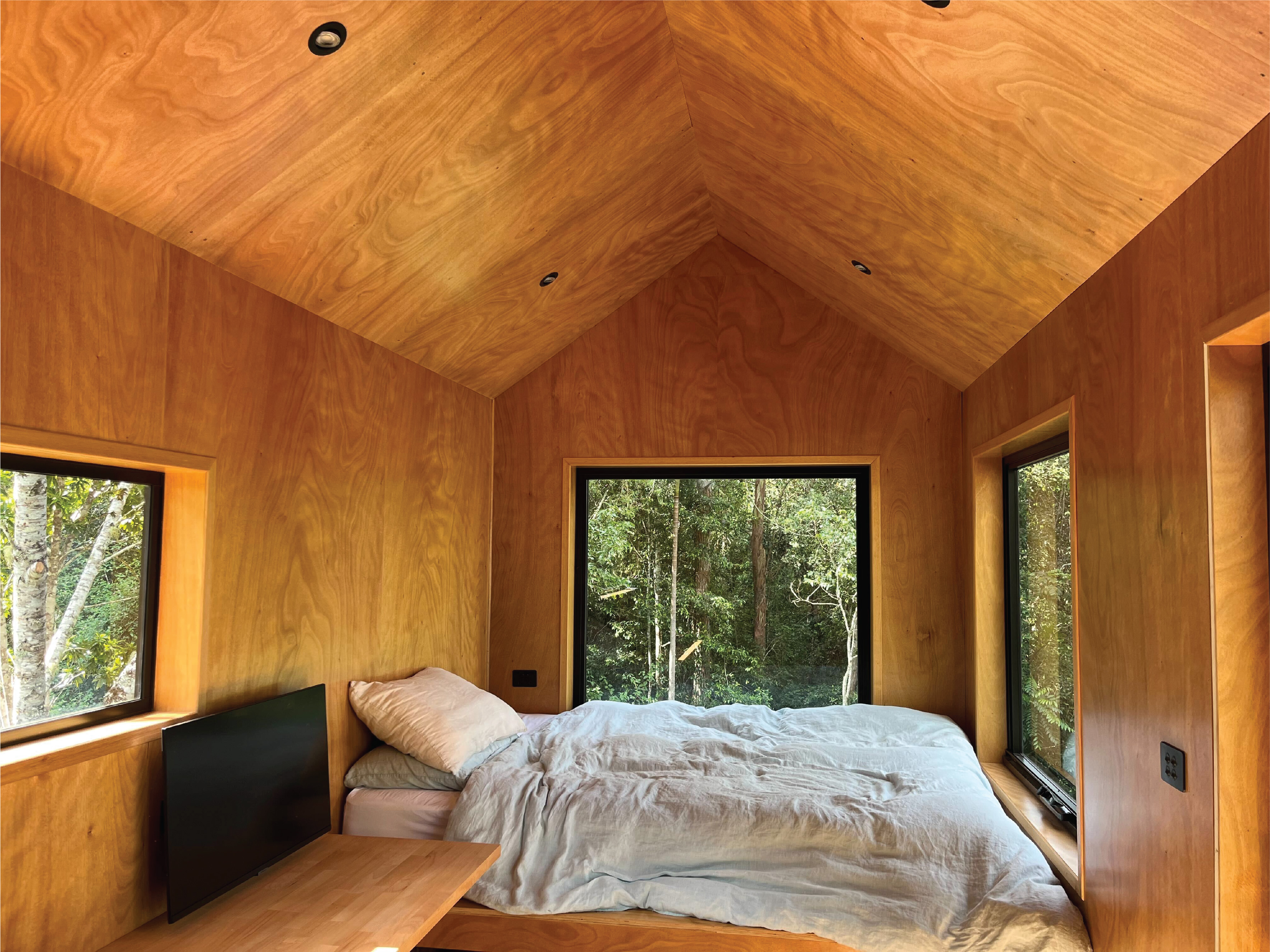
Away runs measurable 3-day nature immersions from The Nature Fix, on the edge of Gondwana rainforest in Bellingen Shire, NSW.
Sources: Atchley, R.A., Strayer, D.L., Atchley, P. (2012). "Creativity in the Wild: Improving Creative Reasoning through Immersion in Natural Settings." PLOS ONE 7(12). | Williams, F. (2017). The Nature Fix. | National Geographic, "This Is Your Brain on Nature" (2016). | Ferraro, F. (2015), replication study, Boundary Waters.